Skip to content
If you notice that your pet goldfish is grotesquely curled up then it’s definitely time to reassess the water quality in your aquarium.
A timely reaction is crucial now, however, you should know how to gradually lower the high nitrate levels in the fish tank in order to avoid causing further stress to your aquatic pets.
What you’re witnessing are signals that the sickness is in its advanced stage.
Your fish is experiencing poisoning caused by elevated nitrate content in the aquarium.
This usually takes place over time unlike the immediate effect of ammonia or nitrite poisoning.
Any form of irrational behavior in fish is to be considered a potential threat to their health.
What causes Nitrate poisoning in aquarium fish?
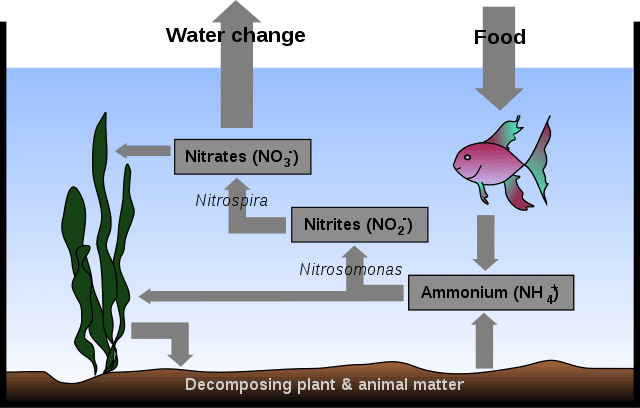
The build-up of Nitrate (NO3-) in the aquarium is the result of the nitrification cycle that naturally occurs in the water.
However, the NO3– ions are not used by aerobic water bacteria and remain in the system until physically removed.
This leads to long-term permanent damage in fish and you should react as soon as you notice ill behavior.
Here’s the reason behind Nitrate poisoning in aquarium fish:
Poisoning can occur in fish if they’re exposed to moderate or high levels of Nitrate contents in the aquarium water for too long. If 20 or more PPM (parts per million) of Nitrate are continuously present in the water, the fish will start showing signs of intoxication.
A sudden rise of Nitrate is also harmful and potentially lethal to aquarium fish.
The most common reason behind Nitrate poisoning is the unchecked build-up of organic compounds in smaller fish tanks.
Elevated contents of Nitrate in aquarium water can kill both freshwater and saltwater fish over time or during a spike.
However, some marine fish species could tolerate up to hundreds of times more Nitrate than the most fragile freshwater fish.
Author’s note: Some species of freshwater fish are more sensitive to nitrate than others. More fragile fish like the Otocinclus, Stingrays, Angelfish, or Discus should be kept in aquariums with no more than 10 ppm of nitrate in the long run.
Bigger fish are less sensitive to nitrates.
As long as the build-up is gradual freshwater fish could tolerate up to 50 ppm of nitrate for a limited period of time. Saltwater fish will show no signs of poisoning with up to 40 ppm. At such levels, however, freshwater fish will inevitably start to show signs of sickness over time.
Still, even lower levels of nitrate can be fatal for fish fry and most invertebrates.
Fish grow the fastest in the juvenile stages of their lives.
Higher nitrates could potentially limit a fish’s maximum size if it’s grown from fry in such conditions.
In coral reef aquariums, nitrate is to be kept at an absolute minimum, preferably below 2 ppm, because at higher levels most of the more sensitive SPS corals could perish.
Another reason for this is that having high Nitrate in a reef tank should come with elevated Phosphate levels in order to prevent coral bleaching. Elevated Phosphate could cause severe algae blooms and other overnutrification issues.
Signs and symptoms of a Nitrate intoxication in fish
In the freshwater fish-keeping hobby, there’s a popular belief that the presence of nitrate in the aquarium’s water is not particularly harmful.
For this reason, many would automatically exclude it as the possible reason behind the symptoms that I’m about to list.
Both ammonia and nitrite can cause fish deaths almost immediately after their appearance in elevated levels, unlike nitrate.
This, however, does not mean that nitrate contents won’t endanger aquarium fish, be it over time.
In fact, nitrate has a similar form of action to nitrite when it enters a fish’s bloodstream.
Just like its deadlier counterpart, nitrate binds to hemoglobin and saps its ability to carry oxygen by transforming it into methemoglobin. Since fish have a significantly lower gill permeability to nitrate, they can tolerate it in higher concentrations without showing any visible signs of poisoning.
With time, however, the buildup of nitrate begins to gradually damage their liver and kidneys, leading to a host of different symptoms.
Author’s note: If you notice any irregular behavior in your pet fish it is best to consult with your local vet.
That being said, here are the signs and indicators of nitrate poisoning in aquarium fish:
- Side swimming;
- Upside-down swimming;
- Going blind;
- A bent body with a curved spine where the fish looks curled up;
- Random erratic movements;
- Lethargic behavior and lack of energy;
- Weak or no feeding reflex;
- Fast movement of the gills as if the fish experiences shortness of breath;
- Lying on the bottom of the aquarium;
- Fading color and a pale look.
Here’s a photo of a fish with a bent spine which signals a severe poisoning:
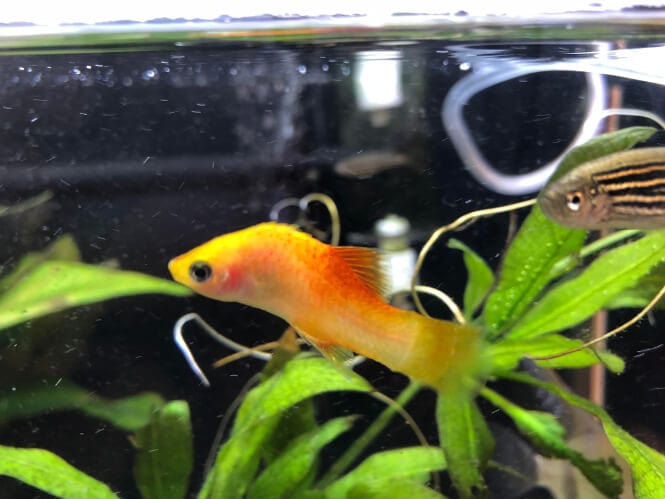
By iknowcraig
When the signs start showing it means that the fish have already suffered for some time.
However, it should be noted that most aquarium fish will adapt to poor water quality, at least to a degree.
This is most obvious in a fish tank that has been running for some time and suddenly its aquatic inhabitants start exhibiting the aforementioned symptoms without an obvious change in the water parameters.
Even if a single fish shows a sign of poisoning it means that the water is polluted and the parameters need immediate adjustment.
Take a look at this photograph of a goldfish poisoned by elevated Nitrate, that displays a curved body in a U-shape:
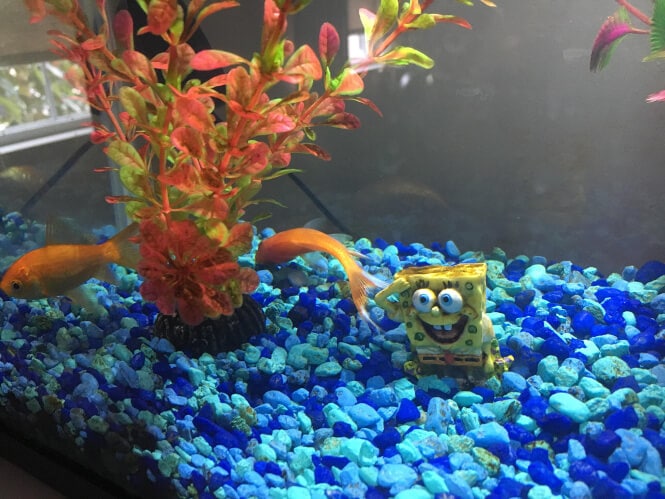
By Jake0743
Sometimes a new fish will show any or a combination of the signs, despite being quarantined and a lack of aggression from its tank mates.
In that case, it may be that you’re running an aquarium that’s too high in nitrate, and here’s why:
The long-term inhabitants have gradually adjusted to the higher nitrate levels over time but the new fish immediately starts showing signs of shock.
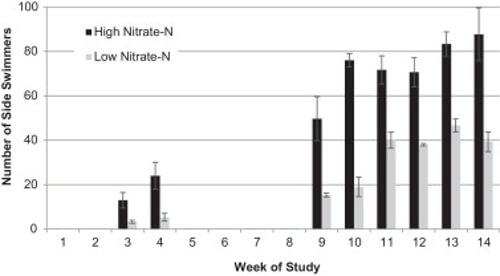
Other known ways of how elevated nitrates affect fish are a weakened immune system, lowered chance of reproduction, and swim bladder disease. The latter causes imbalanced swimming where the fish floats to the top and swims sideways or even upside-down.
The Conservation Fund’s Freshwater Institute conducted an experiment to show the significant correlation between NItrate-rich aquarium water and swim bladder issues.
Here’s a visual representation of the correlation:
Unfortunately, by the time the symptoms become apparent, there’s already a degree of permanent damage.
Though fish can recover from poisonous nitrate levels they will likely become very sensitive to nitrates in the future.
In the most severe cases, a fish that’s poisoned can die in less than 24 hours.
For this reason, you should react quickly and start immediate treatment as soon as you notice the problem.
How to treat the affected fish?
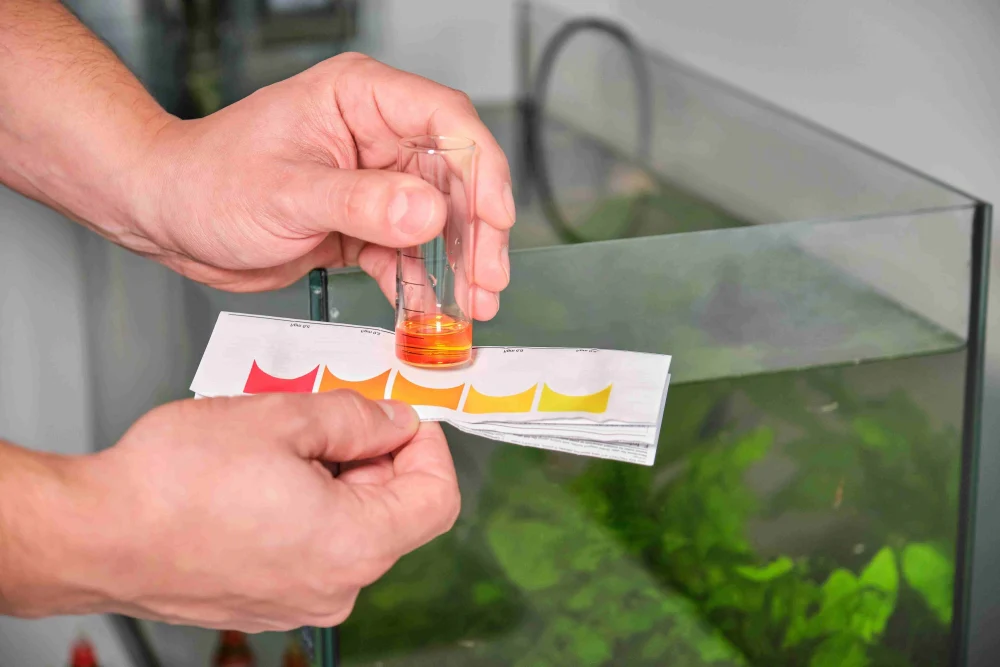
Your first course of action upon spotting any of the aforementioned symptoms is to perform a water test by using a reliable liquid test kit.
A very popular choice for a good water test kit, which I also approve, is the API Master test kit (link to see it on Amazon.com). This kit has freshwater, saltwater, and reef versions so make sure to get whichever fits your setup.
After performing the water test, you’ll be able to establish if the poisoning was caused by a sudden spike in Nitrate or long-term exposure to lower levels.
If the readings fall within what you consider “the norm” for your aquarium, then your fish have likely been poisoned over time.
Depending on the species you keep and how long you’ve kept them, this could even be a reading of 20 ppm.
If, however, the test shows alarmingly high nitrate levels, compared to what your fish tank usually maintains, then it’s safe to say that the poisoning has occurred in the past 24 to 48 hours.
Ideally, in both cases, you’ll want to lower the nitrate content in the aquarium’s water to below 15 ppm and in the case of more sensitive species of fish – to below 10 ppm.
Here are instructions to treat fish that have been poisoned by high nitrate:
To help your pet fish survive the toxic aquarium water you should perform a large water change of up to 40%. Adding clean water will dilute the pollution.
This is more of an emergency cure and it should be viewed as a temporary solution to prevent or put a stop to fish mortalities.
By doing so you’ll buy yourself time to later evaluate the real reason behind the elevated nitrate levels.
The water test results will give you a rough estimation of how large a water change you’ll need to perform.
By Feet4Fish
A general rule of thumb here would be that interchanging 50% of the aquarium water will remove 50% of the nitrates.
Then you should exchange roughly 30 to 35% of the total water volume to bring them down to below 20 ppm.
If the water tests show 100 ppm of nitrate content then you’ll want to perform an 80% water change in order to bring them down to 20 ppm.
However, and this is important for the safety of freshwater aquatic pets, I do not recommend interchanging more than 40% of the total water volume of a fish tank.
This is because…
GRADUAL water replacement is key to avoid shocking your fish
It’s very possible that your fish have partially adapted to the Nitrate in their water at this point.
The sensitivity of fish to nitrate fluctuations goes both ways.
Same as with rapidly rising levels of nitrate, drastically reducing them will put a fish under immense stress.
Such stress can weaken the fish’s immune system even further and impair its osmotic regulation.
Osmoregulation is the ability of fish to regulate their body fluids, which is crucial when it comes to swimming.
Related: My Fish Died After Changing Aquarium Water
A fish’s swim bladder is supposed to be filled with gas.
During disturbed osmoregulation, it fills up with liquid, which then causes buoyancy issues and may eventually kill your pet fish.
Author’s note: It is a common occurance for a fish that has survived a nitrate intoxication event to become bloated. The reason behind this is that impaired osmoregulation causes swollen internal organs. This type of bloat is often observed in aquarium fish kept in smaller tanks such as Betta fish, because the less volume of water is easier to pollute.
To prevent the shock a large water change would cause to a fish during nitrate poisoning you should not change more than 40% of the total water in the aquarium per day. Spread this 40% in multiple smaller water changes of 5% for every 1 hour.
So, if circumstances demand it to perform the largest water change your fish can endure for the day, the whole procedure should take around 8 hours.
You can interchange the remaining water the following day.
And one more thing: In the most extreme cases where aquarium water contains more than 100 ppm of nitrate you should not remove more than 50 ppm per day. This is to prevent the ion imbalance in the water, which could also lead to impaired osmoregulation in fish.
This means that if the aquarium has 200 ppm of nitrate, the maximum volume of the water change should not surpass 25%, which equals 50 ppm of nitrates.
However, if the fish tank has been shown to contain 60 ppm of nitrate, don’t go over the 40% mark of exchanged aquarium water.
An 8-hour long period of small water changes may sound daunting, but if you are fond of your fish, it’s the best possible approach to a safe emergency treatment.
Before you rush to the siphon, however, you should test your tap water.
Tap water as the culprit
In some geographical regions, things like fertilizer runoff and the erosion of natural deposits can leak nitrate in drinking water.
The EPA (the United States Environmental Protection Agency) has set a hard limit of nitrate content to drinking water supplies. To be compliant, each water facility should not allow more than 10 ppm of Nitrate-Nitrogen in the water they provide for drinking.
In the context of fish keeping, we must convert this number to Nitrate ions by multiplying it by 4.43, because nitrate-nitrogen only reports the nitrogen content in a nitrate ion (NO3-).
In fact, tap water all over the world could contain nitrate, depending on the local regulations. For this reason, you should figure out whether your tap water is causing your aquarium’s Nitrate issues in the first place.
If tap water turns out to be the culprit you’ll need to consider a different source for aquarium water changes.
A good recommendation would be RO/DI or Reverse Osmosis / Deionized water which is purified and contains almost nothing but H2O molecules.
This type of water requires remineralization, because freshwater fish get their minerals through their skin, unlike humans. RO/DI water is heavily used in coral reef aquariums where the presence of nitrates can be detrimental to the more sensitive coral species.
In these setups, the aim is to keep nitrate below 2 ppm.
You can find RO/DI water in your local pet store where they sell it by the gallon. You could also get a compact RO/DI filter for aquariums to purify your tap water at home.
An RO/DI water filter requires a higher initial investment but pays for itself with time and is the cheaper option in the long run.
If you dig in Amazon.com you could order some pretty decent RO/DI systems on a budget alongside an inexpensive water remineralizer such as Seachem Stability.
I can save you some time and point you to one such filter that I’m personally happy with, but you can browse around and do your own research.
Other possible causes for high nitrate and how to permanently fix the issue?
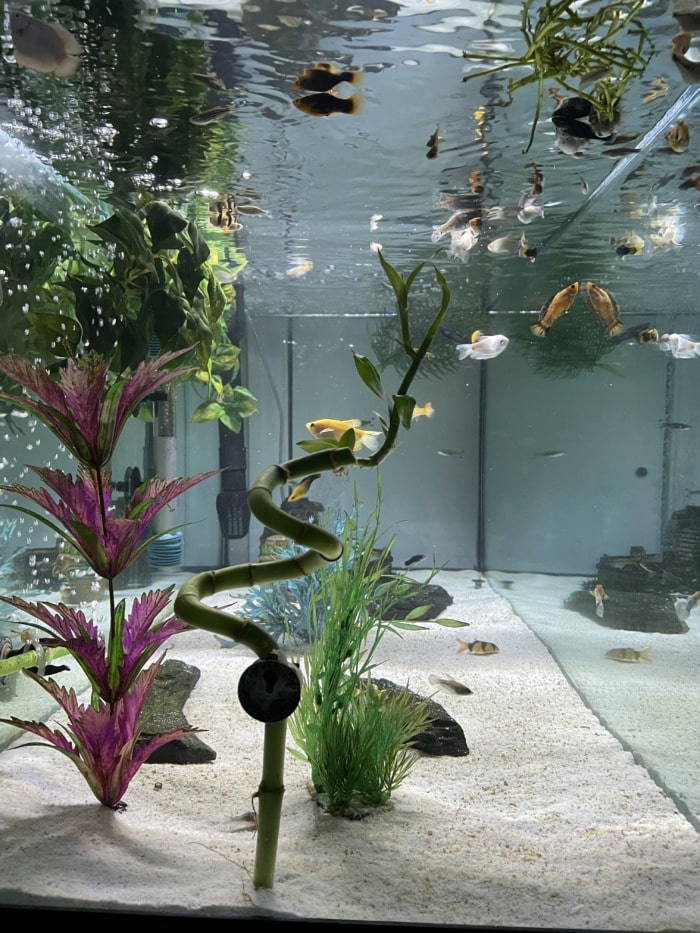
By Affectionate_Text843
Because nitrate is rarely converted to anything in a freshwater aquarium it remains in the system.
Any organics that end up in the system will eventually become nitrate.
The most common reasons for poisonous levels of nitrate build-up are:
- Feeding too often and more than the fish can eat.
Many fishkeepers tend to overestimate the appetite of their aquatic pets.
This leads to a buildup of leftover food which gets turned into nitrate once it decomposes. Fish can survive a surprising amount of time without food, so there’s no need to stuff them with flakes and pellets.
- Overcrowding the aquarium beyond its bioload capacity.
Each aquarium has a certain bioload capacity that’s largely determined by its size.
Larger aquariums can maintain more and bigger fish since their water volume is enough to dilute the increased levels of nitrate.
Moreover, they’re more stable to water parameter fluctuations so they’re also easier to maintain than small fish tanks.
- Having a tank that’s too small to adequately house fish in such a confined space or anything below 3 gallons for a single Betta fish.
Similar to the previous point, many beginners falsely assume they can keep any fish they want as long as it’s small enough to fit their tank.
Some species such as Goldfish, however, produce significantly more waste than other equally sized fish.
Putting them in a small fish tank is nothing short of a death sentence.
- Neglected aquarium water maintenance.
Tedious as they might be, maintenance routines are an integral part in the health of any aquarium system.
Since nitrate removal is mainly done through weekly water changes, skipping them will inevitably pollute your aquarium.
- Old filter media that hasn’t been cleaned of gunk.
The accumulation of gunk on filter media reduces the functional surface for beneficial bacteria and can also decrease water flow.
- The lack of any live aquarium plants.
Aquarium plants are a great way to regulate nitrate levels since they fuel their growth by consuming it.
Naturally, bare tanks suffer from increased nitrate levels.
Aggressively changing water is a short-term fix to immediately reduce the physiological stress the nitrate poisoning has caused to the fish.
For effective long-term solutions after you’ve handled the Nitrate, I strongly recommend checking my guide on permanently lowering the high levels in a freshwater tank. Visit the link to learn about various methods and ideas on commercial and natural nitrate-removing filter media for a freshwater aquarium.
To learn more about managing healthy levels of nitrate in a saltwater tank â click here. Dealing with the underlying reasons behind the contamination would ensure the problem is permanently resolved.
My Personal Advice
Even though fish are fairly tolerant to nitrate, they can get poisoned if they’re continuously exposed to it.
High nitrate levels are more often caused by inexperience than anything else.
As long as you don’t neglect your responsibilities as a fishkeeper, and avoid overfeeding, you’ll never have to deal with nitrate poisoning ever again.
If you haven’t dipped your toes into aquascaping yet, I highly recommend you check up some low-tech setups.
This will help you to maintain stable nitrate levels and let you create a more natural aesthetic.