Skip to content
Checkout these practical tips for managing aggressive barb behaviors such as fin-nipping, overeating, and territoriality in your Tiger Barbs to ensure a successful community aquarium setup.
Tiger Barb: Iconic, Active, and Schooling
Are you looking for an active schooling fish to keep your aquarium entertaining?
Then, you’ll love the Tiger Barb species. It’s a classic striped barb with an energetic and social personality. However, it’s prone to fin-nipping when kept alone with other species and no compatible schoolers.
In this guide, you’ll learn basic Puntigrus tetrazona care tips for keeping this species in a small or large group and how to manage its fin-nipping tendencies. Before you get into the details of tiger barb care, however, you must first understand its origins and why it needs specific care, such as keeping it in a group of 6+ to spread its aggression and help it thrive in your aquarium.
Author’s Note: Check out our post 13 Types of Barbs That Are Perfect for Colorful Beginner Nano Tanks which includes details on even more barbs to choose from!
Natural Habitat & Origins
Tiger Barb is a Southeast Asian freshwater fish originating from the deep slopes of Sumatra, Indonesia. Over time, they migrated to other Asian waters in Singapore and, through collection around the world.
As a riverine barb, Tiger Barbs are adaptable to various conditions but still need well-oxygenated tanks and careful attention to survive and thrive.
To keep this species in your aquarium, you must recreate its natural tiger barb habitat by using available materials, such as driftwood and leaf litter as aquarium decorations, and live plants for vegetation.
When choosing a wild tiger barb, you’ll notice that it has a different color morph from genetically modified varieties raised by hobbyists. And so, you must understand the differences and similarities between each color morph to provide the utmost optimal care for them.
Identification & Color Forms
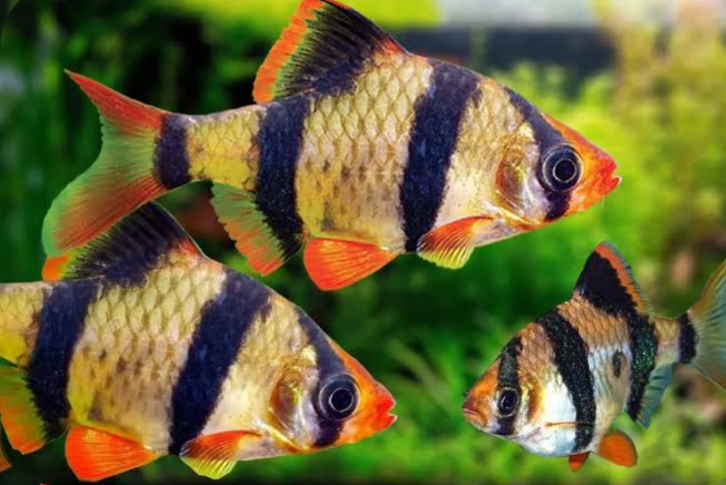
An average Tiger Barb grows between 1.2 and 1.6 inches long and 2.8 – 3.9 inches tall in maturity. Still, with careful and intentional breeding, this striped aquarium fish can add an extra 3 inches to its width.
Besides the overall size, though, Tiger Barbs have different color morphs that identify their breeding grounds.
Color Morphs
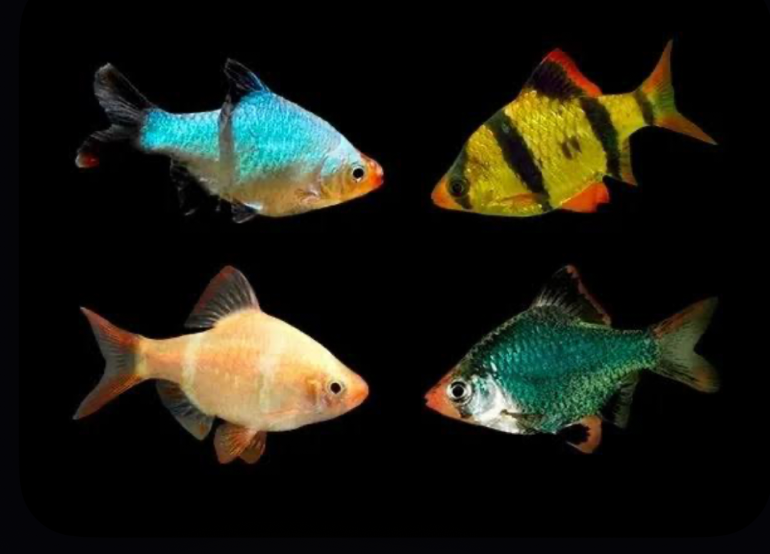
Tiger Barbs are available in three different color varieties due to their breeding history. There’s the native Tiger Barb found in the wild, the Green Tiger Barb, and the Albino Tiger Barb.
Let’s review each of these tiger barb colors.
Native Tiger Barb
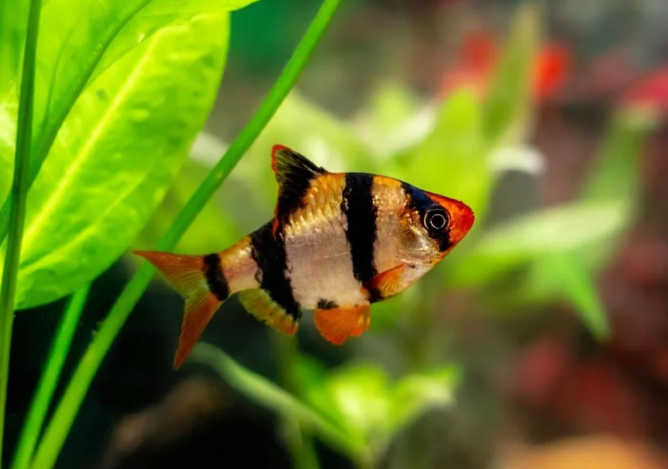
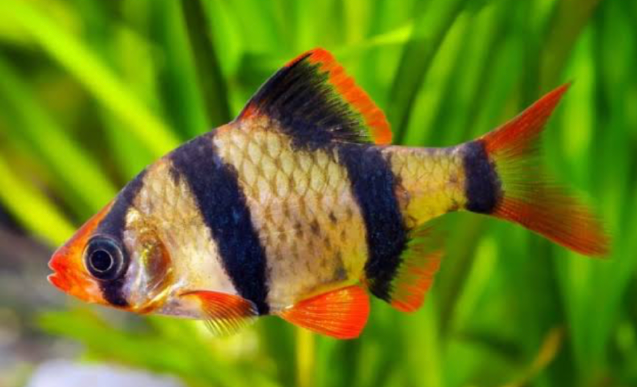
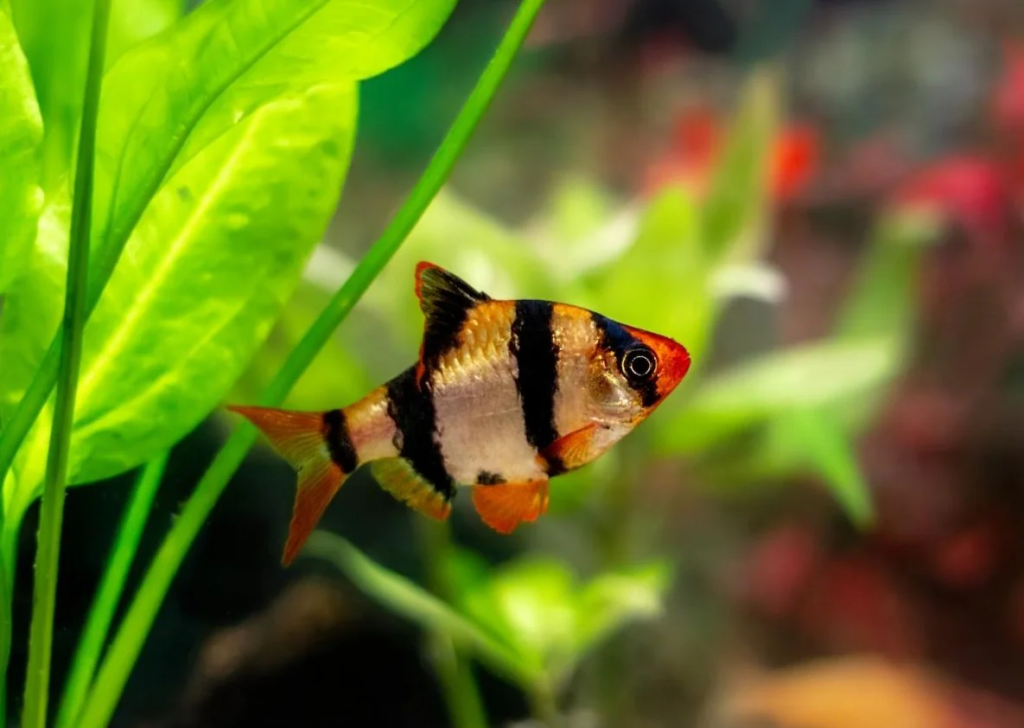
Native Tiger Barbs are the most common morphs because they’re the original species found in the wild. They have a silvery-orange body that’s slightly metallic, with distinct black vertical stripes, similar to those of the wild cat whose name it borrowed. But that’s not all. There’s also a red tint on its fins and snout that draws your attention.
To maximize this unique coloration, hobbyists crossbred these natural wildlings with other species to create other color morphs.
Green Tiger Barb
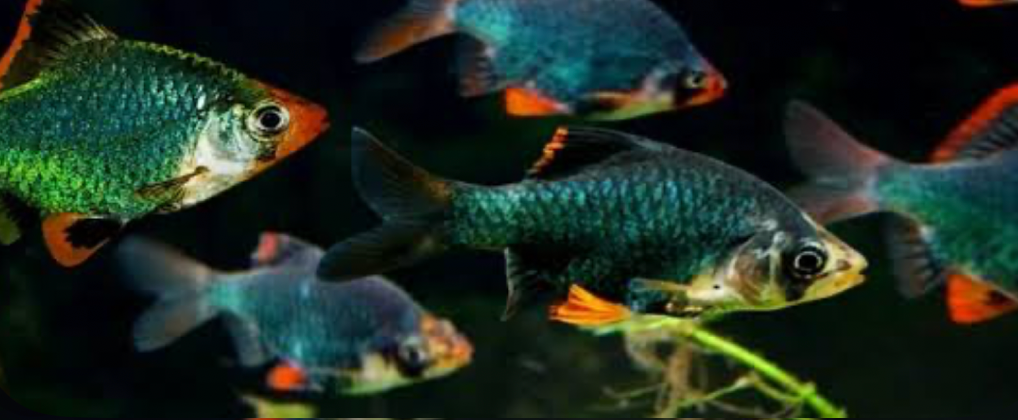
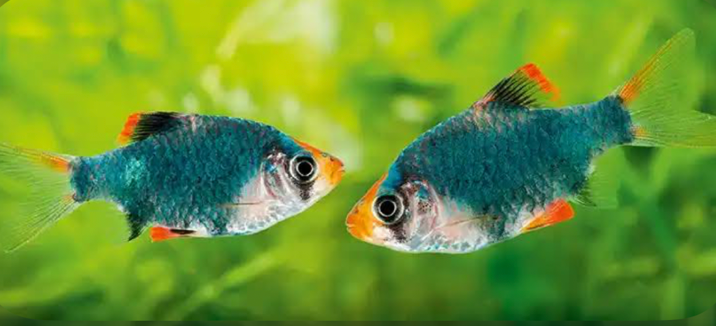
You may see a green tiger barb and think it’s a black-skinned fish because its metallic scales often appear dark black to the point of having almost invisible black stripes. This unique color morph makes some hobbyists call the Green Tiger Barb the Moss Green Barb.
To truly enjoy this metallic scale’s visual beauty, it’s best to accentuate your pet with a vibrant aquascape. Also note that Green Tiger Barbs are more aggressive than wild native morphs.
Author’s Note: Check out our post 13 Types of Barbs That Are Perfect for Colorful Beginner Nano Tanks which includes details on even more barbs to choose from!
Albino Tiger Barb
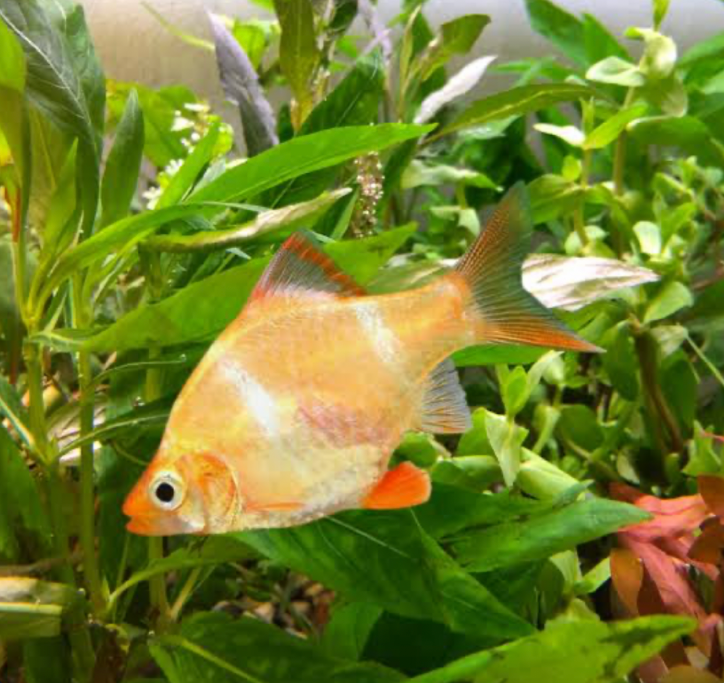
Another unique color morph of this species is the Albino tiger barb. Like all albino fish morphs, this variant has a pale yellow body with faint, still-visible stripes. They have red eyes that are sensitive to light, so they need aquascapes with dark substrates and dim lighting.
Author’s Note: Check out our post on Albino Tiger Barb (Puntigrus tetrazona) Care for an in-depth look at this unique color morph with classic Tiger Barb behavior!
Body Morphs
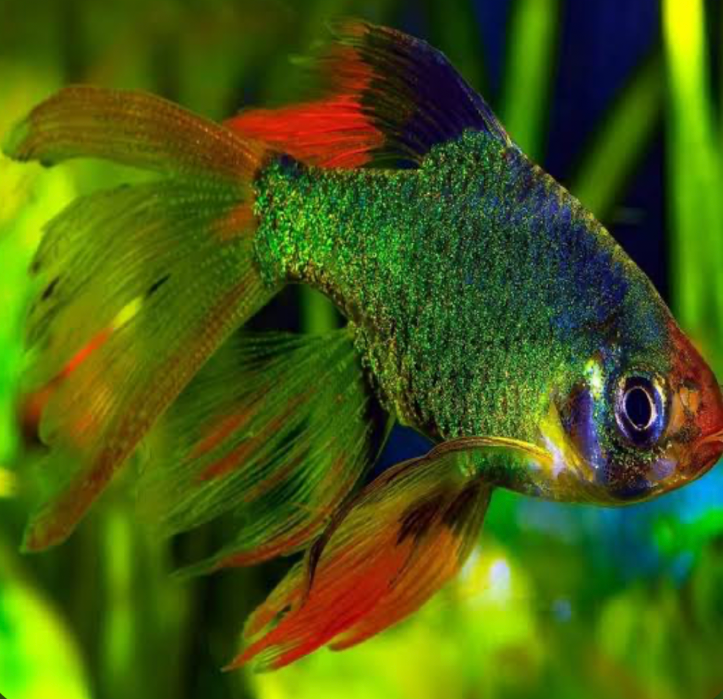
Besides visible color morph differences, some Tiger Barbs have distinct body shapes, such as long-fins and veiltails. These body morphs are rare and often the creation of careful selective breeding, so you won’t easily find them in the wild.
No matter the Tiger Barb variant you get, they always have essential environmental needs suitable for all morphs before you focus on their unique needs.
Tank Size & Grouping
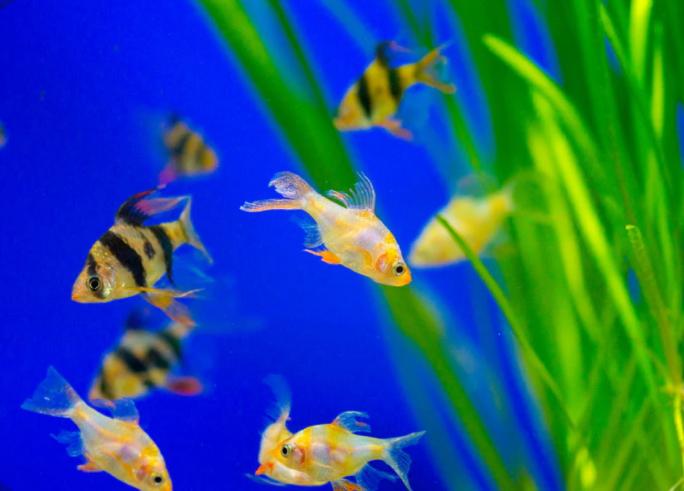
To determine the ideal tank size for your pets, consider their characteristics. Firstly, this species is a schooling pet, so they need to live in a group of similar fish. Secondly, consider their physical appearance based on their body morphs.
Let’s build a community tank for tiger barb pets.
Tank Size
As a beginner, you can start with a Tiger Barb tank size of 30+ gallons for a group of 6. Provide hiding spots in the tank by placing plants and smooth-edged decor strategically along the tank’s walls. This arrangement leaves open swimming zones in the center for your pets to explore and display their vibrant skins as they school.
Grouping
Although the average group size for Tiger Barb fish is six, it’s better to keep them in odd numbers with more females than males to reduce pair aggression and territoriality.
You can mix your schooling group with different color morphs for a visually stunning display, but remember that the Albino Tiger Barb is the calmest of all three, while the Green Tiger Barb is the most aggressive.
Water Parameters & Filtration
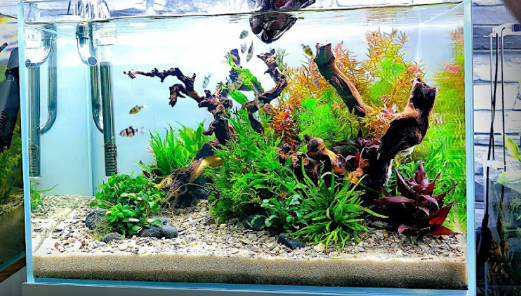
As active swimmers, this species has high oxygen requirements as barbs. To ensure there’s always oxygenation in the tank, you’ll need stable water parameters, a good filtration system to simulate moderate flow, and an active air pump.
Water Parameters
Ideal Tiger Barb water parameters include a temperature of 72 – 80°F, slightly acidic water with a pH level of 6.5 – 7.5, and a soft to moderately hard water mineral level between 5 – 19 dGH.
Filtration System
Your Tiger Barbs would be resistant and adaptable to fluctuating water conditions, but that doesn’t mean you should neglect them.
Add air stones or an air pump to circulate oxygen in the tank, and use a strong device that ensures adequate filtration for active fish like your Tiger Barbs. It’ll keep the water clean after feeding them and simulate a moderate flow.
Diet & Feeding Tips


Freeze-Dried Tetra BloodWorms (Left)
Tropical Semi-Floating Micro Pellets (Right)
Despite being an ornamental species, Tiger barbs are not picky about their food. They eat everything from plants to animal sources. But you have to be careful with what tiger barbs eat, when they eat, and how they eat to avoid health complications.
Dieting Needs
As omnivores, your pets need a balanced barb diet of all food groups. Get them high-quality flakes or pellets for complete nutrients in one staple.
Supplement their staple diet with rich protein for barbs through live foods such as bloodworms, brine shrimps, and daphnia. You can feed them these protein sources in their live forms, frozen, or dried forms.
Author’s Note: For more on feeding your aquatic pets check out The Ultimate Guide to Fish Food: Pros and Cons & Best Choices!
Feeding Tips
As protein-lovers and fast eaters, your Tiger Barbs are prone to overfeeding and choking on their food. So, use a strict and regimented tiger barb feeding schedule to control their tendencies.
Ensure the portion is no more than they can finish in 2 minutes. Feed multiple small portions at least two to three times daily to reduce competition and encourage measured eating.
Behavior & Tank Mate Rules
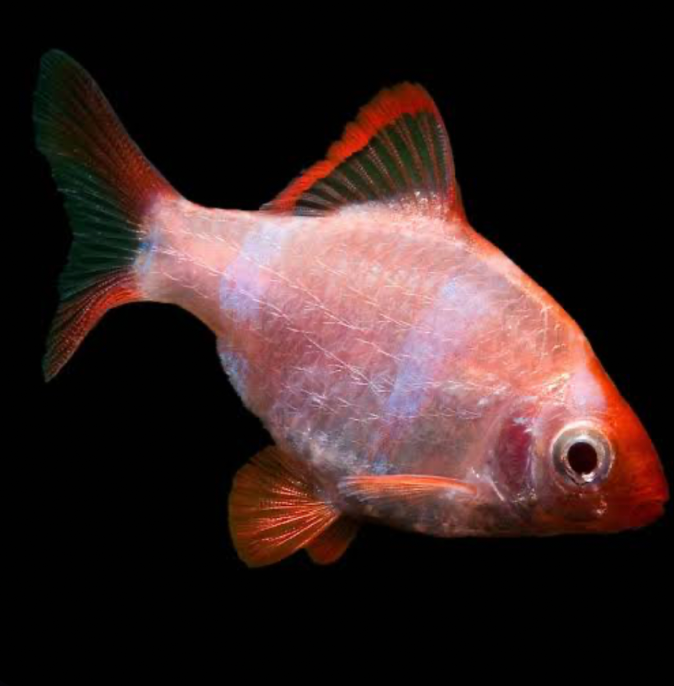
All Tiger Barbs tend to get aggressive and nip at their tankmates’ fins. So, here is a fin-nipping solution for your aquarium community.
Behavior
Fin-nipping tendencies in your Tiger Barbs are symptoms of unstable conditions and improper grouping. Look out for the following triggers:
- Angled and conflicting water flow
- Loneliness from having fewer than six Tiger Barbs in a group
- Long-finned tank mates
Set the water flow to a stable, moderate level, like a river, and ensure the aquascaping is leveled and not unusually angled.
Tank Mates
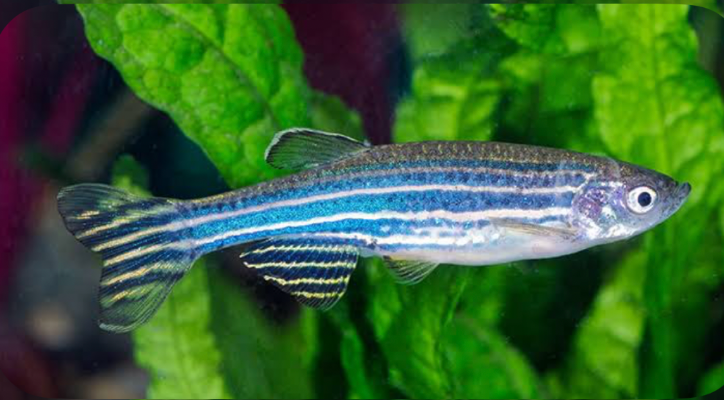
Choose suitable and compatible tiger barb tank mates, especially for their school group, if you’re thinking of diversifying your fish community. Keep them in schools with similarly sized, robust tankmates that also love schooling, such as Danios and Platys.
You can also add bottom-dwellers like loaches for diversity, but avoid long-finned fish, slow-movers, and larger fish such as Bettas, Gouramis, and Angelfish.
Health & Disease Prevention
Although Tiger Barbs are hardy and adaptable pets, they’re prone to certain diseases and health challenges due to their other characteristics. Here’s a look at some common Tiger Barb disease, their causes, treatment, and prevention.
Disease Causes and Treatment
Tiger Barbs are prone to columnaris, also known as cottonmouth disease, a bacterial infection. You can treat this immediately by increasing the tank temperature to speed up the bacteria’s lifecycle and by improving water conditions.
Stress causes grainy, white, salt-like spots to appear on your pet’s body. You can prevent ich in barbs by reducing stress, ensuring proper grouping, feeding your pets a balanced diet, and setting up a spacious tank for comfortable schooling.
Quarantine to protect the tank before introducing it.
Health Maintenance
Always quarantine aquarium fish for at least 4 weeks before adding them to your community. It helps you to ensure they’re healthy enough to join the rest. Use this strict quarantine protocol for other living organisms, such as small snails and live plants.
Two weeks is an ideal quarantine period to ensure they’re in optimal health and suitable for your tank.
Always disinfect your aquarium tools, especially your nets, before and after use, and keep separate tools for distinct tanks. You can maintain clean water and stable conditions with daily monitoring and 25% – 50% bi-weekly water changes, depending on the tank size.
Don’t overcrowd your tank in a bid to encourage schooling. Maintain a ratio of 6 Tiger barbs per 30 gallons of water, and add an extra 10 gallons for each new addition. Scroll up to see more tips on setting up an ideal tank with adequate grouping.
Breeding & Spawning
Tiger Barb breeding requires skill, care, and discipline, as this species has certain peculiarities. For instance, they’re egg scatterers during breeding, so you must prepare your breeding tank to capture all the eggs after spawning.
Keep reading to see more essentials for successful barb keeping and breeding from the conditioning stage to the reintroduction stage.
Breeding Tank Setup
Start by setting up a separate breeding tank for your adult Tiger Barbs. Get a 5 – 10 gallon-sized tank with dense live plants such as Java Moss and Java Fern as cover for the eggs after spawning. Increase the water temperature to the highest acceptable level.
Breeding Pair
Choose healthy Tiger Barbs that are at least 6 – 7 weeks old as your breeding pair. If you have more than 2 breeders for reproduction, ensure there are more females than males and maintain a ratio of 1 male to 3 females.
Females are larger with rounder bellies, while the males are smaller with more vibrant colors.
Condition your breeding pair by feeding them a high-protein diet at least 2 weeks before breeding day. When they’re ready to breed, you can move the pair to your breeding tank.
Spawning
The females spawn at dawn and scatter their eggs across the tank. If you prepare your breeding tank well, the spawning mops, live plants, or saucers in the gravel will catch the clusters of eggs, which can be up to 500.
Eggs & Fry
Separate the adults from the eggs and convert your breeding tank into a fry tank as you prepare to raise Tiger Barb fry. The eggs hatch within 24 – 36 hours after spawning, but won’t become free-swimming fry until after another 4 – 5 days.
During this period, feed the developing Tiger Barb juveniles with infusoria until they have mouths that can chew crushed baby brine shrimp and other processed but high-quality fry food.
Watch them for the next couple of weeks until they attain maturity by 4 – 5 weeks. Then, move the grown Tiger Barbs to your main tank.
Lifespan & Care Level
If you successfully manage Barb’s aggression and provide your pets with the utmost care, they’ll live about 5–7 years in good health. It doesn’t matter if you’re a first-time hobbyist or a professional fishkeeper. Your Tiger Barb lifespan depends on how well you use the tips in this guide.
So, are you ready to keep this beginner active schooling fish as your aquarium’s centerpiece?
Conclusion
After reading this Tiger Barb guide and tips for managing barb behavior, such as fin-nipping, overfeeding, and territoriality, you should be ready to keep Tiger Barbs.
Yes, this species is a dramatic pet with unique variants and characteristics, but they’re fun. If you can commit to providing proper schooling conditions, tankmates, and basic care needs, your pets would flourish.
As an aquarist seeking animated community displays, you can rely on this spectacular schooling fish to deliver a memorable show every time. Get your Tiger Barb schooling group today and enjoy this pet’s company for the next 5 – 7 years.