
The ultimate guide to keeping Barbs, a lively, colorful, and adaptable freshwater fish species ideal for small and medium-sized aquarium community setups.
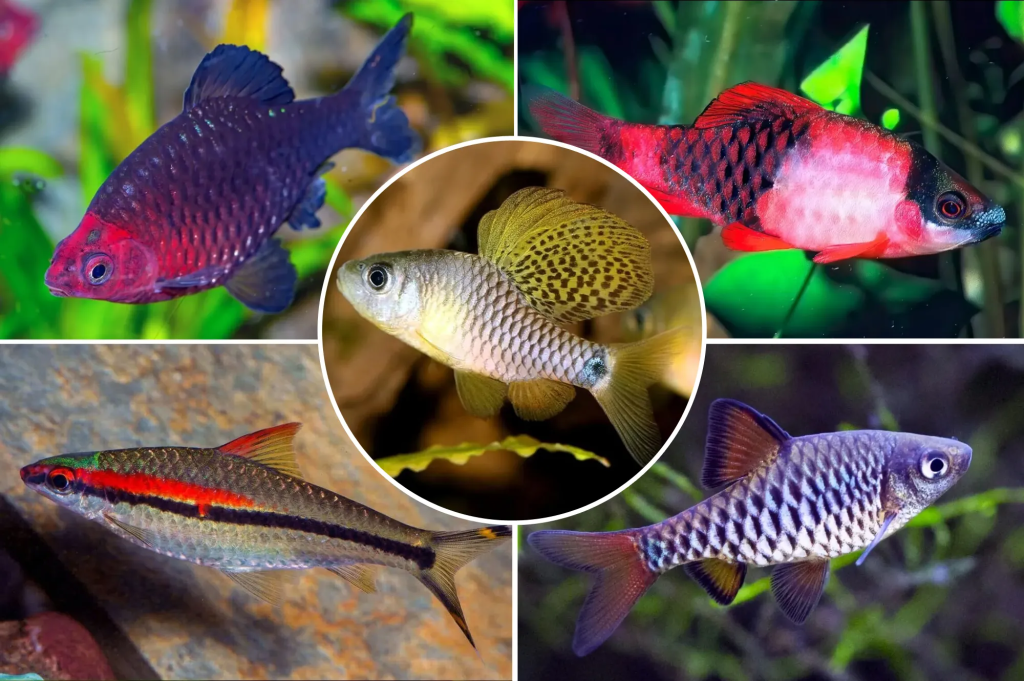
Why Barbs Make Excellent Beginner Nano Fish
Colorful aquarium fish are always the top pick for community setups because of their vibrant appearance, but Barbs offer way more than just looks.
Barbs are a peaceful to semi-aggressive schooling fish, depending on species, from the Minnow family, known for their small size, lively personalities, colorful appearance, and adaptability. These qualities make them a great starter fish for nano and mid-sized aquariums, whether in species-only or community setups.
If you’re a new aquarist looking for a beginner barb fish to grace your tank, you’re in the right place. This guide highlights 13 popular types of barb fish suitable for nano, small, and medium tanks, running from summery cherry barbs to patterned tiger barbs and moody black barbs.
No matter your personality, you’ll surely connect with at least one of these vibrant minnows, and if you want a splash of barb colors, there are enough to fill your medium tank and create a standard school of four to six barbs.
Cherry Barb (Puntius titteya)
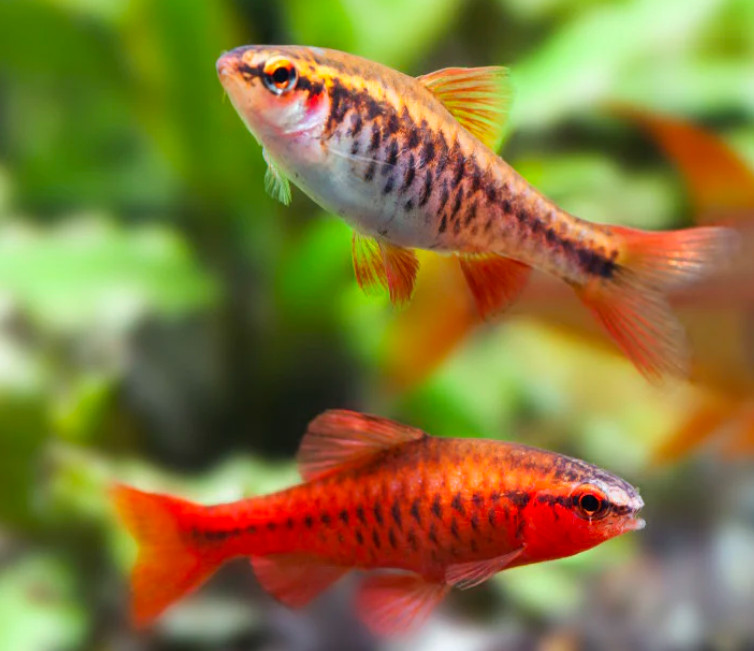
We’re starting strong with the cherry barb fish, a peaceful, bright red variant that reaches up to 2 inches in maturity. It earned its name from its bright red color, which stands out against any background, including planted tanks.
You can use the brightness of this small red barb’s scales to determine its sex because the male species are often more vibrant during breeding season. Meanwhile, the females appear in a duller shade of red, which may appear light pink, with a rounder belly.
This vibrant red nano fish is great for community aquariums because of its schooling nature. It’ll interact with other peaceful fish in its environment and capture your attention with its graceful swimming. Here’s how you can care for this beginner aquarium species:
Care Tips for Cherry Barb
Get a small tank that holds at least 20 gallons of water to house a standard group of 6-8 of these peaceful schooling fish. The company will keep them lively and healthy by encouraging your Cherry barbs to move around the tank.
Set the following water parameters to ensure the environment is conducive and similar to their natural habitat:
- Temperature: 73 – 81℉
- pH: 6 – 7.5
- Hardness: Soft to Hard
Note that cherry barbs are omnivorous and will eat plant-based and animal-based foods. So, feed them a diet of high-quality flakes and micro pellets with frozen, freeze-dried, and live foods.
Author’s Note: Check out our post A Comprehensive Guide to Cherry Barb for an in-depth look at this beautiful fish!
Rosy Barb (Pethia conchonius)
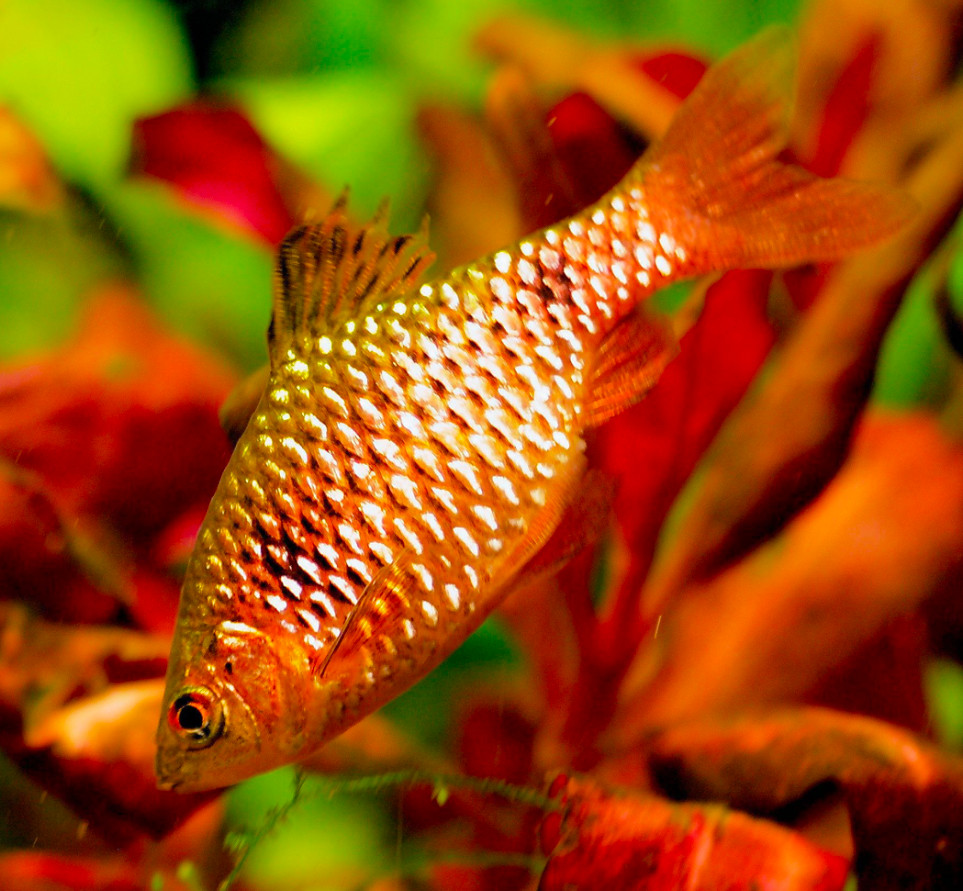
Unlike the Cherry barb, the Rosy barb fish is slightly larger, as the adults grow between 4 and 6 inches. However, they’re also hardy, adaptable, and active, which makes them a great centerpiece for 20+ gallon tanks.
Rosy barbs also have different shades depending on their sexes, and it becomes obvious during the breeding season. The male variants have a rosy-red shade, while the females, which are often large, appear with a silvery undertone that makes them shine like rose-gold.
Unlike Cherry barbs, this pink aquarium fish is only semi-peaceful because discomfort can make them nippy. So, here’s how you can make this hardy beginner fish comfortable.
Care Tips for Rosy Barb
Prepare a cooler water setup with more space to accommodate the Rosy barb’s size and temperament.
- Temperature: 64 – 72℉
- pH: 6.0 – 8.0
- Hardness: Moderate
Keep a minimum of size in the group to prevent this low-temperature barb from nipping fins and getting bored.
Because they’re faster swimmers than most barbs, Rosy Barbs eat more food to replenish their energy and stay agile. Feed them protein-rich foods, such as flakes, pellets, and vegetable supplements to keep them healthy.
Gold Barb (Barbodes semifasciolatus var. schuberti)
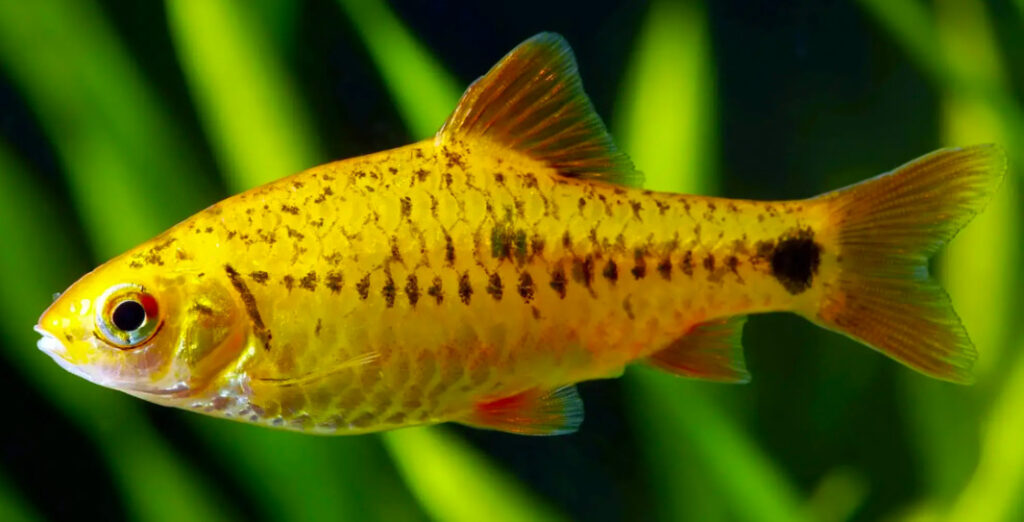
For a showstopping variant, get the gold barb fish. It’s a metallic variant developed by selective breeding of a green tiger barb with a yellow barb in the 1950s. An adult Gold barb grows to 2-3 inches, with females larger than males.
This golden aquarium fish then stood out for its metallic scales, which glow under LED lights. If you look closely, you can still see thin dark green stripes with faint spots on the Gold Barb’s body.
Gold barb variants are a suitable beginner fish because they’re easy to maintain and thrive in groups of 6-10, including other peaceful species.
Care Tips for Gold Barb
You’ll need a minimum of 20 gallons of water in a tank to comfortably hold about 6 Gold barbs. They enjoy open swimming, including a large swimming area in the aquascaped tank, and fill the tank with dense vegetation.
- Temperature: 68 – 79℉
- pH: 6.0 – 7.5
- Hardness: Soft to moderately hard
Feed this peaceful barb high-quality commercial foods, such as pellets and flakes, supplemented with live foods and blanched vegetables, including spinach and zucchini.
Odessa Barb (Pethia padamya)
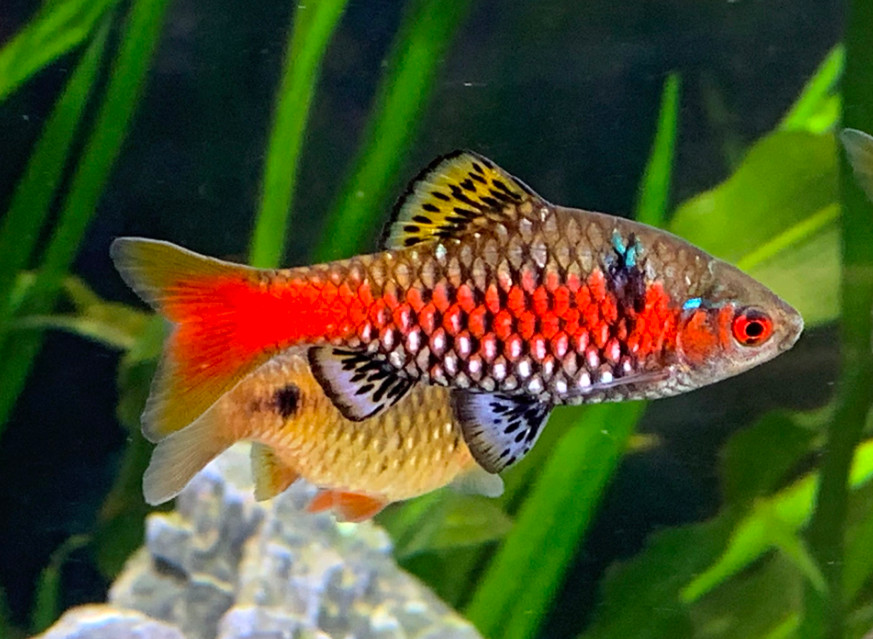
Another small, reddish-looking variant you’ll like is the Odessa barb. It’s a 2- to 3-inch barb with a silver body and a striking red stripe. Although its color intensifies with a good diet rich in carotenoids and protein, its shade depends on the sex.
Female Odessa barbs have a silver-gold body that’s duller than the male’s, and they lack the additional black mark on the red stripe. These striking colors make the Odessa variant a planted tank barb, as it’s sure to stand out against dense vegetation.
You can keep this colorful community fish healthy and happy by pairing it with other peaceful barbs, guppies, rasboras, or corydoras in a suitable habitat.
Care Tips for Odessa Barb
Set the following water parameters:
- Temperature: 72 – 79℉
- pH: 6.5 – 7.5
- Hardness:
Ensure there’s at least 20 gallons of water in the tank for a group of 6, and feed this red-stripe fish a rich, omnivorous diet of live, plant-based foods and vegetables to boost its colors.
Tiger Barb (Puntigrus tetrazona)
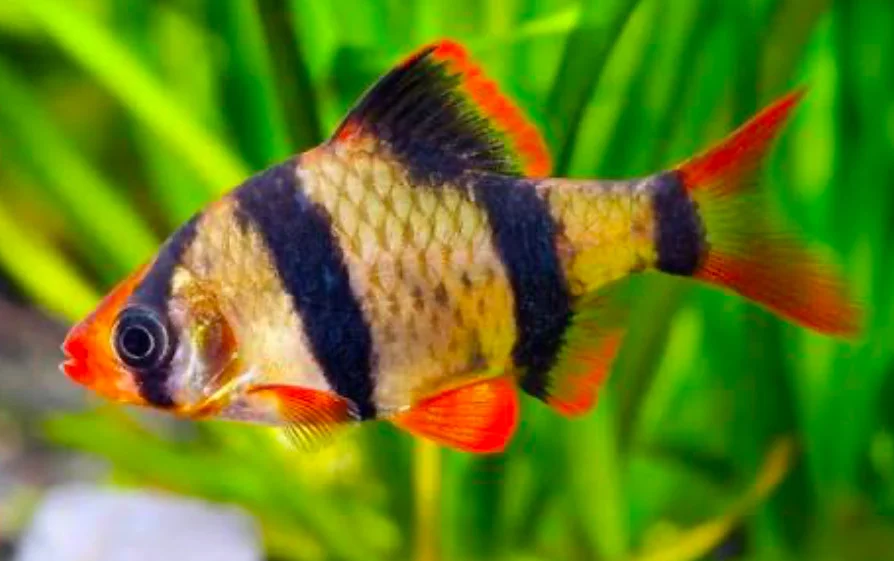
An iconic, lively aquarium fish that deserves multiple mentions in this guide because of its subvariants is the Tiger Barb. This Southeast Asian variant is more energetic and social than most barbs, so that it can come across as semi-aggressive in some settings.
Like its animal namesake, this variant has a gold-orange body with vertical black stripes across. Due to crossbreeding and selective breeding over the years, this striped barb fish has other color variants, such as the Green Tiger Barb and Albino Tiger Barb, which we’ll mention soon.
But first, here’s how to manage tiger barb care.
Care Tips for Tiger Barb
Keep this beginner-active fish in groups of 6+ to reduce fin-nipping and maintain similar habitat conditions to its natural environment. Set the following water parameters:
- Temperature: 74 – 80℉
- pH: 6.0 – 7.5
- Hardness: Soft – Moderate
Like other variants, Tiger Barbs are omnivorous, but be careful during breeding season because the adults tend to eat their eggs. Separate the breeding tank from the main tank so that you can properly monitor the fry development.
Green Tiger Barb
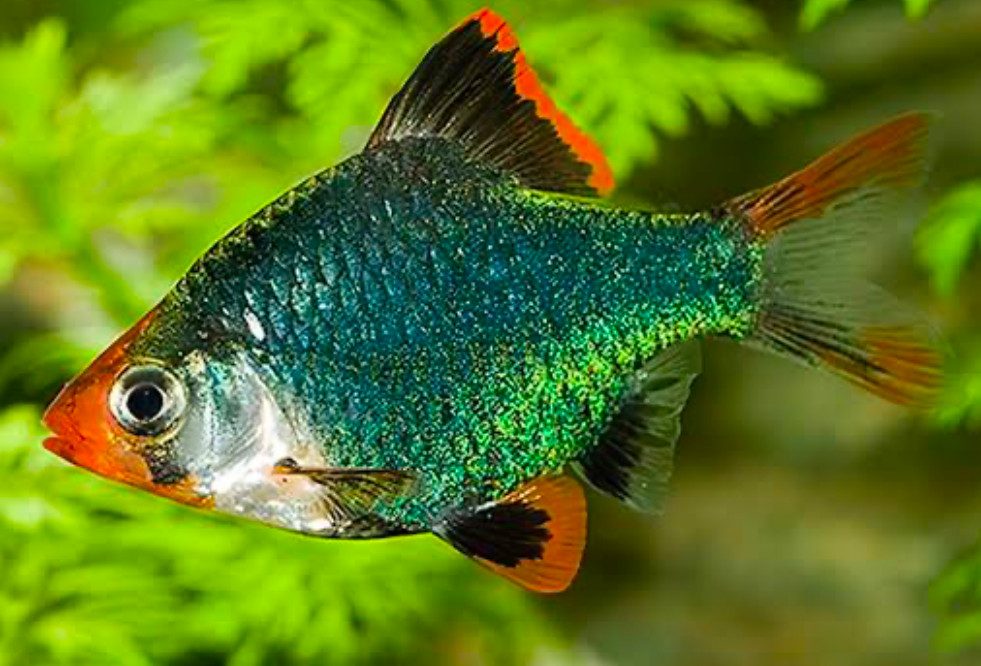
The Green Tiger Barb is a color morph of the Tiger Barb variant, with a metallic green sheen rather than the gold-orange body. Its black stripes aren’t visibly separate, and so they appear as a solid green shade, while the males have a unique red tint on the edge of their fins.
Green Tiger Barbs share the same temperament and characteristics as Tiger Barbs, so only choose them if you want a centerpiece fish that can add contrast to a nano aquarium.
Care Tips for Green Tiger Barb
Set the same water parameters as Tiger Barbs for this active aquarium fish.
- Temperature: 74 – 80℉
- pH: 6.0 – 7.5
- Hardness: Soft to Moderately Hard
Feed this colorful beginner fish with high-quality flakes and micro pellets, as well as frozen, dried, or live foods, and vegetables as supplements. Note that during breeding, they’re not nurturing, so separate the adults from the eggs quickly.
You won’t get bored with this nano tank species, but here’s another color morph that may interest you, up next.
Albino Tiger Barb (Puntigrus tetrazona)

The albino tiger barb is a creamy orange-gold fish with red fins and a mild temperament. Sometimes, its appearance is a pale gold body with pink-tinted stripes, orange or red fins, and bright red eyes.
If you want a Tiger Barb without the attitude, then get this peaceful Barb variant, when kept in adequate conditions.
Care Tips for Albino Tiger Barb
To encourage this fish to be mild-tempered fish such as this one, provide a group of 6-8 barbs per school to encourage shoaling without aggression. Also, get a medium-sized tank of about 30 gallons with a large swimming area, plants, and adequate water parameters.
- Temperature: 74 – 80℉
- pH: 6 – 7.5
- Hardness: Soft – Moderate
If this orange aquarium fish and the other variants are too bright for you, then check out this next barb.
Black Ruby Barb (Pethia nigrofasciata)
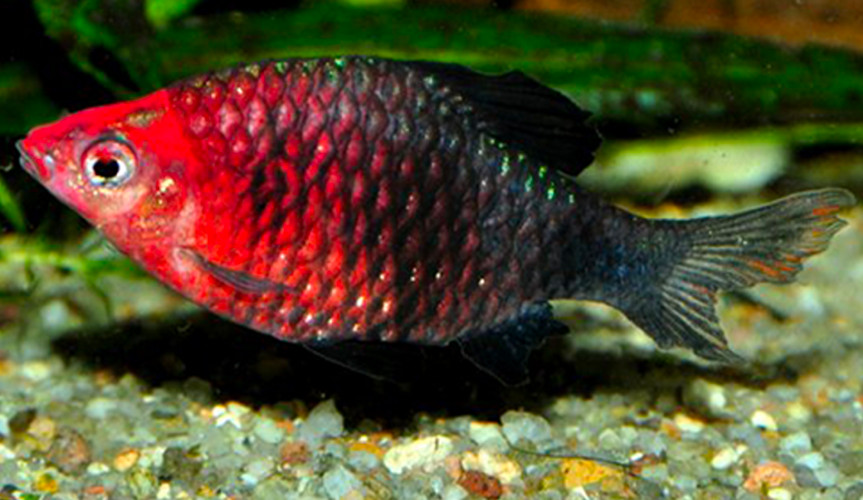
As an aquarist in love with dark themes and motifs, you should look to the Black Ruby Barb as your choice variant. This Sri Lankan beginner barb species has the typical peaceful, active, and social barb temperament, but it stands out for its appearance.
Black Ruby Barb is a red aquarium fish that can turn dark purple in mature males or golden with distinct bars in mature females. However, during breeding season, both sexes retain their red coloring, with the males turning a deep shade of ruby.
Due to their origins, this variant thrives in dimly lit tanks with dense vegetation.
Care Tips for Black Ruby Barb
To properly care for this low-light aquarium fish, get a minimum of 20 gallons and set the following parameters.
- Temperature: 72 – 79℉
- pH: 6.0 – 7.5
- Hardness: Soft to Moderately Hard
Ensure you layer the tank with dark substrates and reduce the lighting to keep it dim. Also, set a slight current in the water flow to mimic Sri Lankan waters and feed your Black Ruby Barb with an omnivorous diet.
Denison Barb (Roseline Shark)
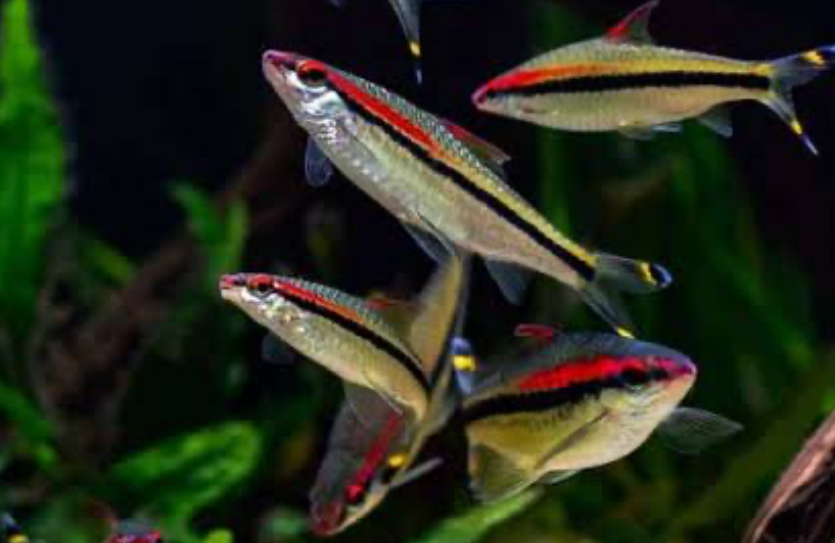
For aquarists who love to stand out, the Denison Barb, also known as the roseline shark, is a suitable choice. It’s a barb variant with unique features and abilities, such as its torpedo shape and fast swimming. Although it’s also one of the most popular colorful barb species, this variant is larger than most, growing to 5-6 inches as an adult.
Denison barbs have silver bodies with a bold red and black line across and a yellow-black tail fin. Due to its love for swimming fast, this large community fish needs enough space in a bigger tank.
Needs space to swim; best for advanced beginners with 55+ gallon tanks.
Care Tips for Denison Barb
Get a large tank that holds at least 55 gallons of water and set the following parameters:
- Temperature: 72 – 78℉
- pH: 6.5 – 7.5
- Hardness: Moderately hard
Maintain a well-oxygenated water with a steady flow and secure the tank with a lid to keep your Denison Barbs from jumping out. Set up a river-style aquascape by adding smooth rocks with live plants to the tank. Note that this isn’t a beginner variant because of its advanced care needs.
Author’s Note: Check out our post Roseline Torpedo Shark (Sahyadria denisonii): A Peaceful Streamlined Beauty for Freshwater Tanks which provides a comprehensive guide to this fish!
Snakeskin Barb (Desmopuntius rhomboocellatus)
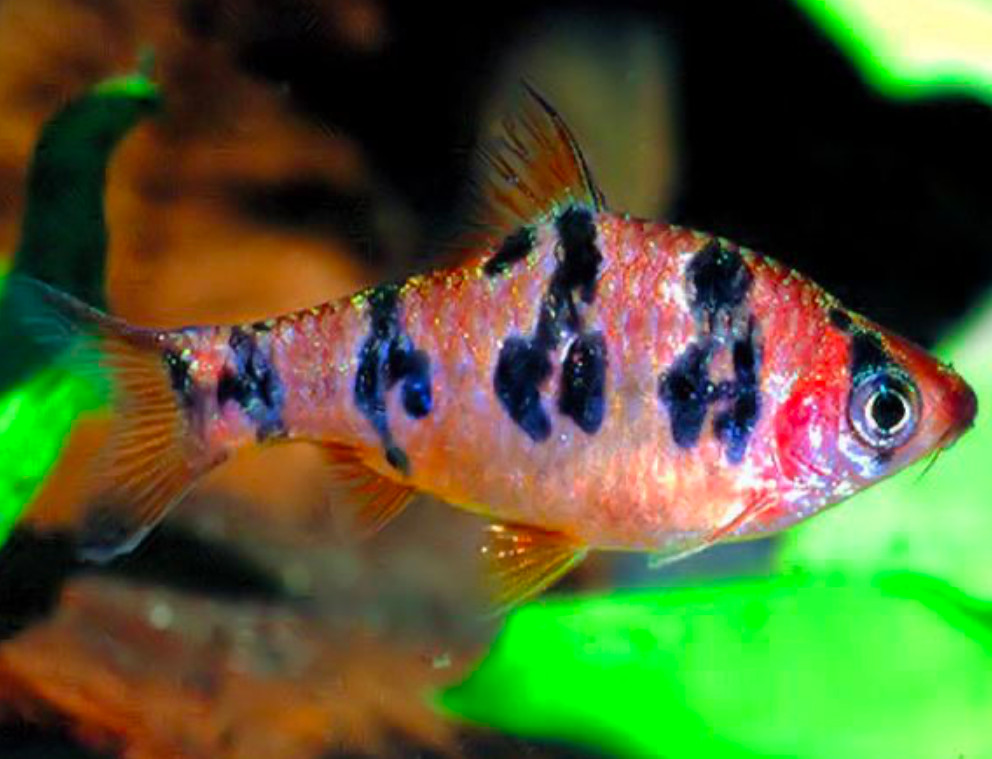
If you like intricate snakeskin patterns, get the Snakeskin Barb fish. It’s a native variant of the ponds and streams of Northern Thailand. Despite being a nano barb at 1.5-2 inches, the Snakeskin variant stands out for its distinctive silvery or golden body with detailed snake-like patterns.
Care Tips for Snakeskin Barb
This small, peaceful beginner fish thrives in soft, slightly acidic water with a slow, stream-like current.
- Temperature: 72 – 79℉
- pH: 6.0 – 7.5
- Hardness: Soft to Moderate
This patterned aquarium fish enjoys living in groups of six or more inside 20+ gallons of water and would feed on an omnivorous diet.
Checkered Barb (Oliotius oligolepis)
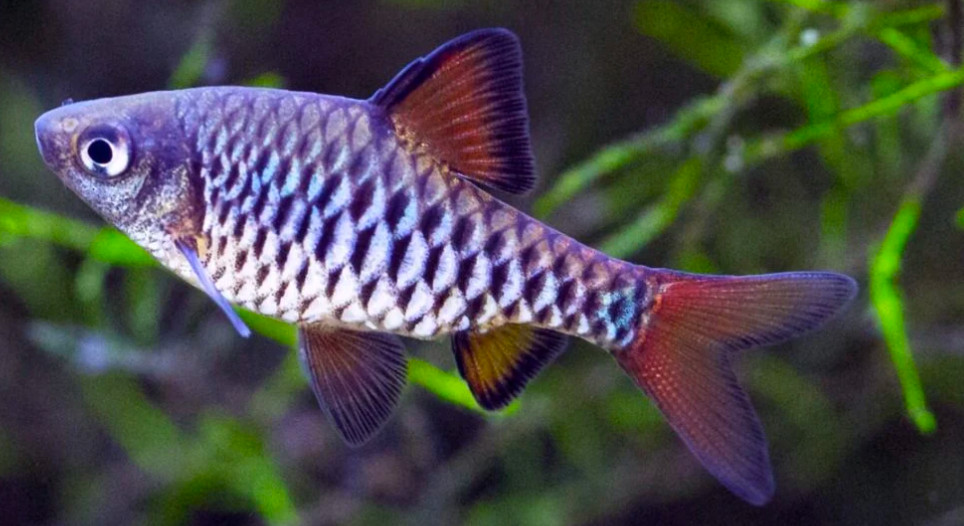
Another mini barb species you can add to your community is the Checker or Checkered Barb fish variant. It’s an active yet peaceful species with a silver or golden body, orange fins, and a striking black pattern that forms checks, hence the name.
Unlike most of the other barbs in this list, this small barb species is underrated, which makes it a rare beginner choice for your tank.
Care Tips for Checkered Barb
The ideal water parameters for this peaceful nano fish are:
- Temperature: 72 – 79℉
- pH: 6.0 – 7.5
- Hardness: Soft to Moderate
Create an open swimming area within dense vegetation in a 15-gallon tank for an average of 6 Checkered Barb fish. Also, feed them with live and plant-based foods to enhance their colors.
Five-Banded Barb (Desmopuntius pentazona)
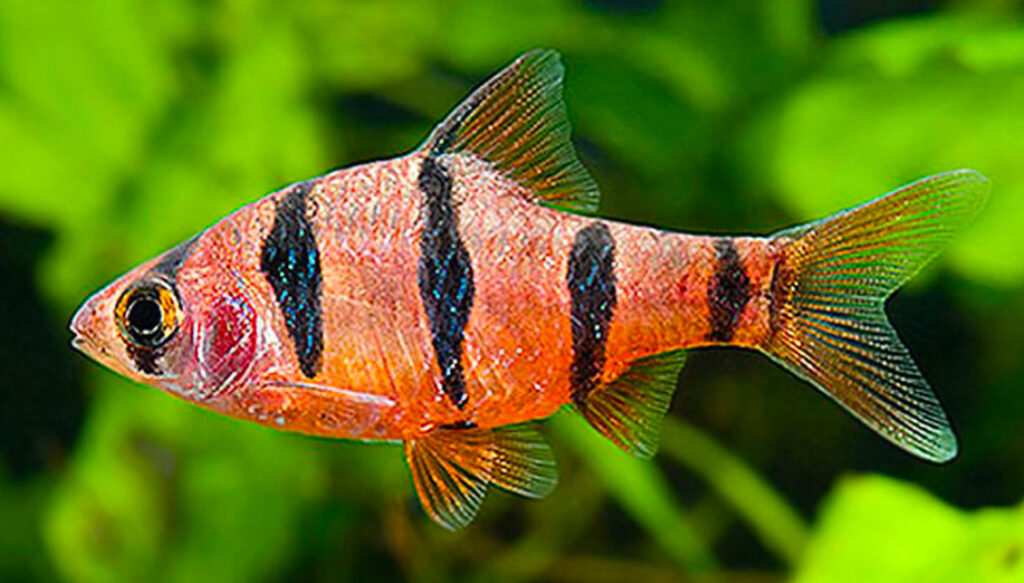
Many beginner aquarists mistake the Five-Banded Barb for the Tiger Barb because of their similar appearance, but they’re different. They’re smaller, calmer, and have distinctive five bands instead of four across their golden-orange bodies.
Because of their calmer temperament, this small striped fish is suitable for a nano community.
Care Tips for Five-Banded Barb
For nano barb care, ensure you feed them a rich, balanced omnivorous diet and set the following water parameters.
- Temperature: 73 – 79℉
- pH: 5.5 – 7.0
- Hardness: Soft
Infuse heavy plantings and driftwood into the tank’s aquascaping to release tannins. Also, maintain a slow flow to avoid stressing this gentle community fish.
Golden Dwarf Barb (Pethia gelius)

Finally, we’ll close this list with the Golden Dwarf Barb, a tiny, gentle, and charming variant that is ideal for true nano tanks. If you want a single nano aquarium fish for your 10-gallon tank, then this is the one.
Golden Dwarf Barbs have soft, golden yellow bodies with faint dark spots. A single adult grows no more than 1 – 1.5 inches and can thrive with shrimps and micro rasboras. This miniature barb fish is sensitive and shy, but also peaceful and sometimes social.
Care Tips for Golden Dwarf Barb
To care for this small schooling fish, ensure you keep a planted tank with enough hiding spots, dark substrates to enhance its color, and set up the following water conditions:
- Temperature: 70 – 78℉
- pH: 6.0 – 7.5
- Hardness: Soft to Moderate
Feed your Golden Dwarf Barbs micro pellets, crushed flakes, microworms, and frozen foods. You need to treat them like fry because they’re tiny and can’t chew on normal-sized foods.
Conclusion: Active, Colorful, and Beginner-Friendly
With so many colorful Barb fish options, you can now start your active beginner aquarium. It’s okay not knowing which one of these fabulous types of barbs to choose at first glance. Take your time to study their distinctiveness and care needs before settling on a variant.
Consider the appearance, temperament, and, most especially, the care needs. So, if you’re looking for a beginner nano fish only, choose between Golden Dwarf Barb, Five-Banded Barb, and Checkered Barb. But for a regular-sized or small colorful and peaceful community fish, you can pick any of the Cherry Barb, Rosy Barb, or Black Ruby Barb. If you want a slightly aggressive barb, then choose the Tiger variant, while expert aquarists can handle the Denison Barb.
One thing’s for sure, Barbs bring constant motion and color to beginner aquariums.


7 thoughts on “13 Types of Barbs That Are Perfect for Colorful Beginner Nano Tanks”